


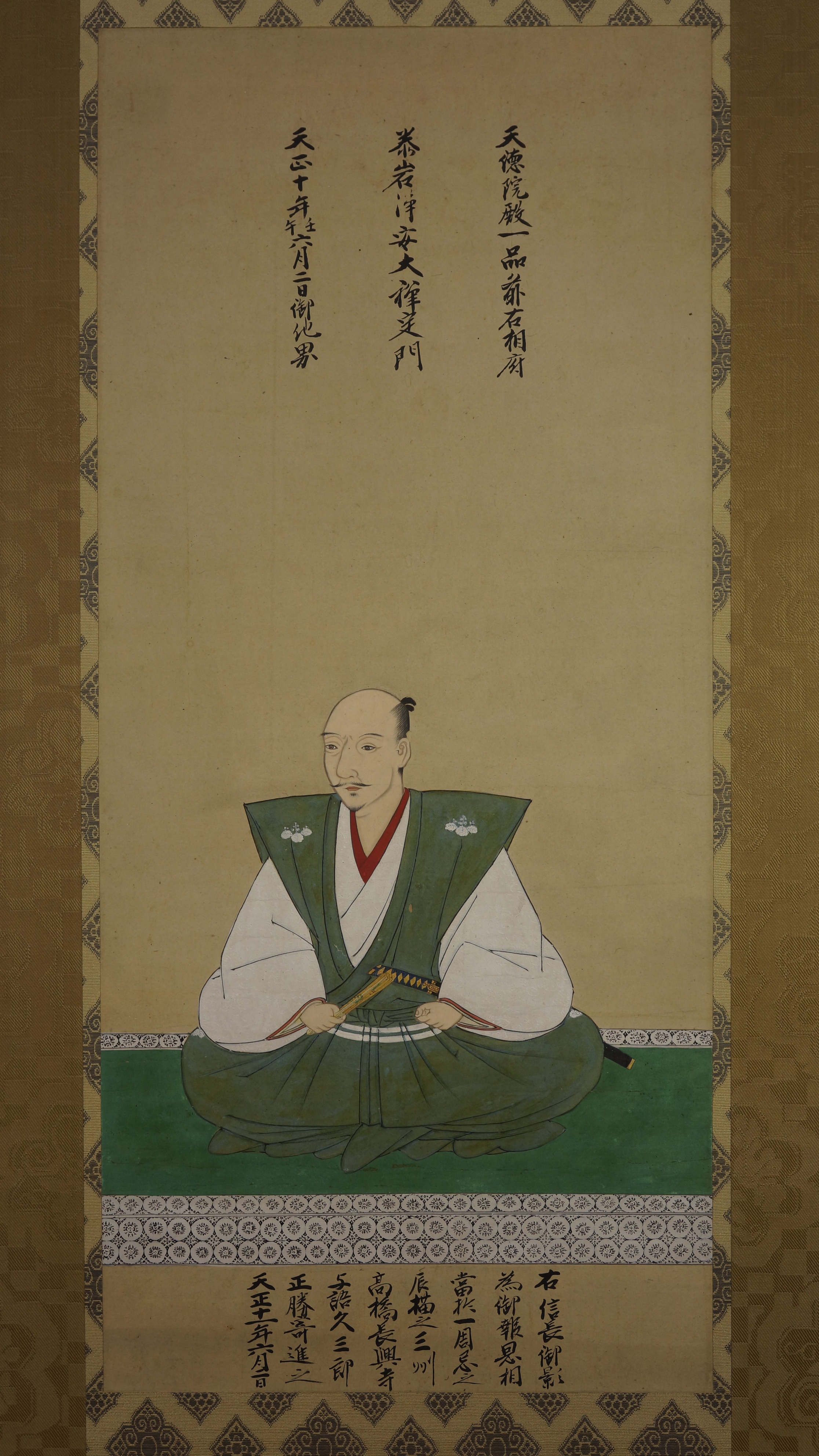
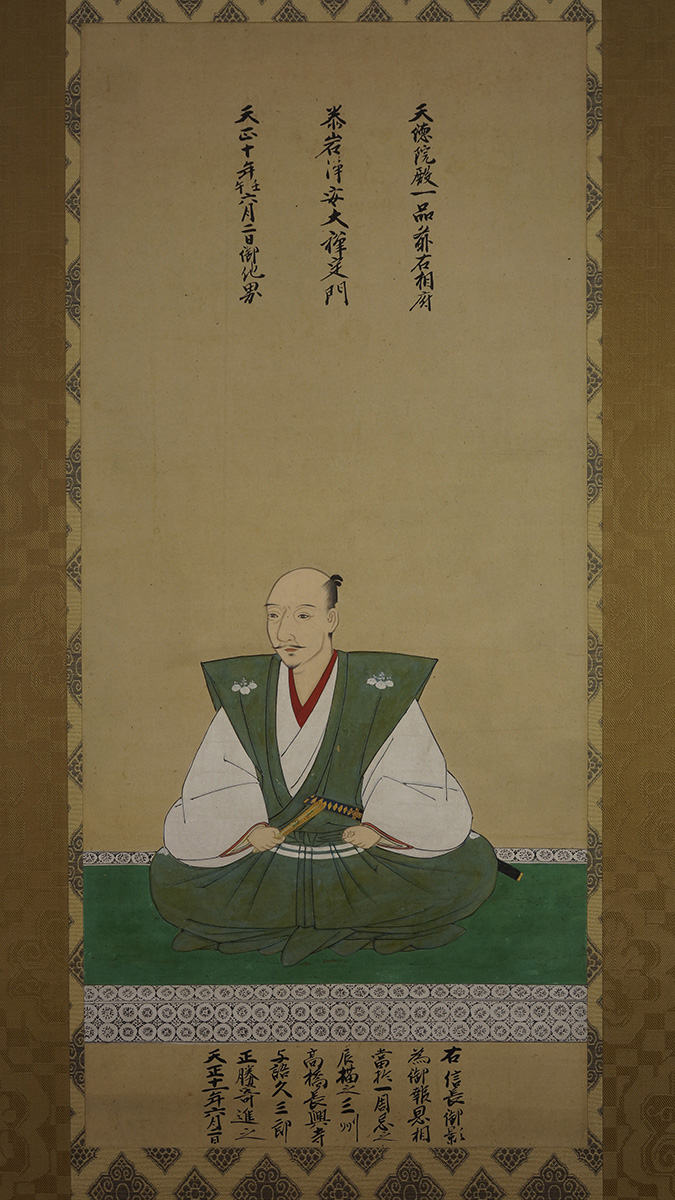
One hanging scroll, color on paper, 70.0 × 31.2 cm. It bears a donation inscription by Yogo Masakatsu.
According to the inscription, on 2 June of Tenshō 11 (1583) — the first anniversary of Nobunaga’s death — Nobunaga’s retainer Yogo Kyūzaburō Masakatsu commissioned the painter Kanō Motohide to create this portrait as an act of gratitude. He then donated it to Chōkō-ji Temple, which he had helped rebuild after it was destroyed by fire.
This is a memorial portrait intended for memorial services and veneration. Nobunaga is depicted seated on a raised tatami without a head covering, wearing a pale green kataginu (shoulder garment) with a paulownia crest on the shoulder. The horizontal line of the kataginu shoulders reflects a style characteristic of the Tenshō–Keichō period. He holds a fan in his right hand, his left hand is lightly clenched, and a short sword is tucked at his side.
His face has a pointed, egg-shaped jaw with clearly rendered features: thin eyebrows, almond-shaped eyes with double eyelids and pupils drawn in the center, a long large nose, a small mouth with an “八”-shaped mustache extending almost horizontally, and a small beard on the chin. The composition — with the body facing forward and the face turned slightly to the right — forms a long isosceles triangle, a typical portrait format of the Kanō school of the period.
The painter Kanō Motohide was the son of Kanō Sōshū (younger brother of Kanō Eitoku). The painting is normally kept in a designated facility and is not on permanent public display.